Submitting a tender can feel like the end of a long process.
You have reviewed the documents, written the answers, gathered evidence, completed the pricing and checked the portal. The deadline is close, and the natural instinct is to upload the files and move on.
But before you press submit, it is worth taking one final step back.
Many tender mistakes happen near the end of the process. A missing attachment, weak evidence point, inconsistent price, unanswered sub-question or wrong file version can damage an otherwise strong submission. This is especially frustrating because many of these issues are avoidable.
A final tender writing checklist helps you check that your bid is compliant, complete and easy for the buyer to evaluate.
This guide sets out the key checks SMEs should complete before submitting a tender response.
Start with the submission instructions
Before reviewing the quality of the writing, go back to the tender instructions.
These instructions tell you how the buyer wants the tender submitted. If you miss them, the response may be marked down or rejected before the evaluator reaches your best answers.
Check:
- Submission deadline and time
- Portal or email submission method
- Required file formats
- File naming instructions
- Word or character limits
- Page limits
- Attachment rules
- Pricing schedule format
- Required declarations
- Signature requirements
- Whether separate envelopes or sections are needed
- Whether late submissions are accepted
Do not rely on memory. Tender documents can be detailed, and different buyers use different rules.
If the opportunity is public sector, the Government Commercial Agency’s guide to writing an effective tender bid is a useful external reference because it reinforces the importance of clear structure, relevant evidence and tailored responses.
Check every mandatory requirement
Mandatory requirements should be checked before the final quality review.
These are the pass/fail items that may determine whether your bid is considered at all. They can appear in the selection questionnaire, instructions to tenderers, specification, pricing schedule, conditions of participation or portal questions.
Common mandatory requirements include:
- Insurance levels
- Accreditations
- Policies and procedures
- Financial information
- Relevant case studies
- Technical certifications
- Health and safety documents
- Safeguarding information
- Data protection information
- Modern slavery statements, where relevant
- Declarations and confirmations
- Conflict of interest statements
- Minimum experience requirements
If a requirement is mandatory, treat it seriously. A strong written response may not save a bid that fails a pass/fail condition.
Create a simple compliance table and mark each item as complete, incomplete or not applicable. If something is not applicable, make sure the tender allows you to treat it that way.

Confirm every question has been answered
Tender questions often contain several parts. One of the most common mistakes is answering the main topic but missing a sub-question.
For example, a mobilisation question might ask about:
- Timescales
- Key milestones
- Roles and responsibilities
- Communication
- Risk management
- Continuity of service
If your response only explains the timeline, you may lose marks for the missing areas.
Before submitting, read each question again and highlight every instruction. Then check the answer line by line.
Ask:
- Have we answered the exact question?
- Have we covered every sub-point?
- Have we followed the buyer’s wording where useful?
- Have we avoided drifting into unrelated content?
- Would an evaluator easily find each part of the answer?
This check is simple, but it can make a major difference.
Review the scoring criteria
A tender response should be reviewed against the scoring criteria, not just against how well it reads.
Check the evaluation weighting for each section. If a question is worth 25% of the quality score, it should contain stronger evidence, clearer structure and more detailed review than a lower-weighted question.
For each scored response, ask:
- What is the buyer actually scoring?
- Does the answer follow the scoring guidance?
- Have we shown method, evidence and outcomes?
- Have we explained buyer benefits?
- Have we addressed risk?
- Have we included enough detail for a high score?
- Have we used the word count well?
A response can sound professional and still be weak if it does not follow the scoring route.
This is a useful point to bring in an independent reviewer. Someone who has not written the answer is more likely to spot gaps, assumptions and unclear wording.
Check the evidence
Tender evaluators need proof, not just positive statements.
Before submitting, review every claim and ask whether it is supported by evidence.
For example, if the response says:
“We have extensive experience delivering similar contracts.”
The evaluator may want to know:
- How many similar contracts?
- Who were they for?
- What did they involve?
- What results were achieved?
- Why is the example relevant?
Evidence can include:
- Case studies
- KPI results
- Contract examples
- Client feedback
- Audit outcomes
- Staff qualifications
- Accreditations
- Mobilisation examples
- Complaints data
- Social value outcomes
- Performance dashboards
- Renewal or retention information
You do not need to overload every answer with detail. But wherever you make an important claim, try to support it with a relevant proof point.
If your evidence is limited or difficult to find, our Bid Ready support can help you prepare case studies, policies and supporting information before the next opportunity lands.

Make sure the response is buyer-focused
A tender response should not read like a general company brochure.
Before submission, check whether the bid clearly explains how your approach benefits the buyer, service users or contract.
For each answer, ask:
- Why does this matter to the buyer?
- How does this reduce risk?
- How does this improve service quality?
- How does this support continuity?
- How does this make contract management easier?
- How does this help the buyer achieve the stated outcomes?
For example, instead of only saying:
“We will hold monthly contract meetings.”
Add the benefit:
“Monthly contract meetings will give the buyer clear visibility of KPI performance, risks, actions, complaints and improvement opportunities, helping issues to be resolved before they affect service users.”
This type of wording helps the evaluator understand the value of your method.
Remove vague claims
Tender responses often contain phrases that sound positive but add little value.
Look for wording such as:
- “We are committed to excellence”
- “We pride ourselves on quality”
- “We work collaboratively”
- “We take a proactive approach”
- “We deliver best practice”
- “We put customers first”
- “We will ensure a seamless service”
These phrases are not always wrong, but they need practical detail behind them.
Replace vague claims with specifics:
- Who will do the work?
- How often will it happen?
- What process will be used?
- What records will be kept?
- How will performance be measured?
- What happens if something goes wrong?
- What evidence proves the approach works?
A final edit should remove filler and protect the content that earns marks.
Check consistency across the whole bid
The buyer may read your quality responses, pricing documents, policies, CVs, case studies and attachments together.
Inconsistencies can weaken confidence.
Check for mismatches such as:
- The quality response promises weekly reporting, but the pricing does not include management time
- One answer says the Contract Manager is the main contact, while another names the Operations Director
- A social value commitment is not reflected in the delivery plan
- A mobilisation timeline differs between two documents
- Case study dates are inconsistent
- Staff numbers differ across the response
- A policy says one thing while the method statement says another
- Environmental claims are not supported by current practice
This is why a full-bid review matters. The submission should tell one clear, consistent story.

Review the pricing carefully
Pricing should be checked separately from the written answers.
A rushed or inconsistent pricing schedule can create serious problems. You may price too high to compete, too low to deliver properly, or in a way that does not match the quality response.
Before submission, check:
- Every required pricing cell is completed
- Formulas work correctly
- VAT treatment is understood
- Labour costs are accurate
- Travel is included where needed
- Materials, equipment or software costs are included
- Mobilisation costs are considered
- Management and reporting time is included
- Subcontractor costs are correct
- Social value commitments are resourced
- Assumptions are clear where allowed
- The price aligns with the service model described
If the written response promises a high level of support, reporting or mobilisation, the price needs to allow for that. If the price is lean, the delivery approach needs to remain realistic.
A tender is not just about winning. It needs to be deliverable if you are awarded the contract.
Check social value commitments
Social value can help strengthen a tender, but only if the commitments are realistic and measurable.
Before submitting, review each commitment and ask:
- Is it specific?
- Is it proportionate to the contract?
- Is it linked to the buyer’s priorities?
- Can we genuinely deliver it?
- Who will be responsible?
- When will it happen?
- How will it be measured?
- How will progress be reported?
- Is it reflected in the pricing or delivery plan if needed?
Avoid broad commitments such as:
“We will support the local community wherever possible.”
A stronger commitment might be:
“During year one, our Contract Manager will coordinate one employability workshop with a local college or community partner agreed during mobilisation. Attendance, feedback and follow-up actions will be recorded and reported through the quarterly contract review.”
That gives the buyer something clear to evaluate.
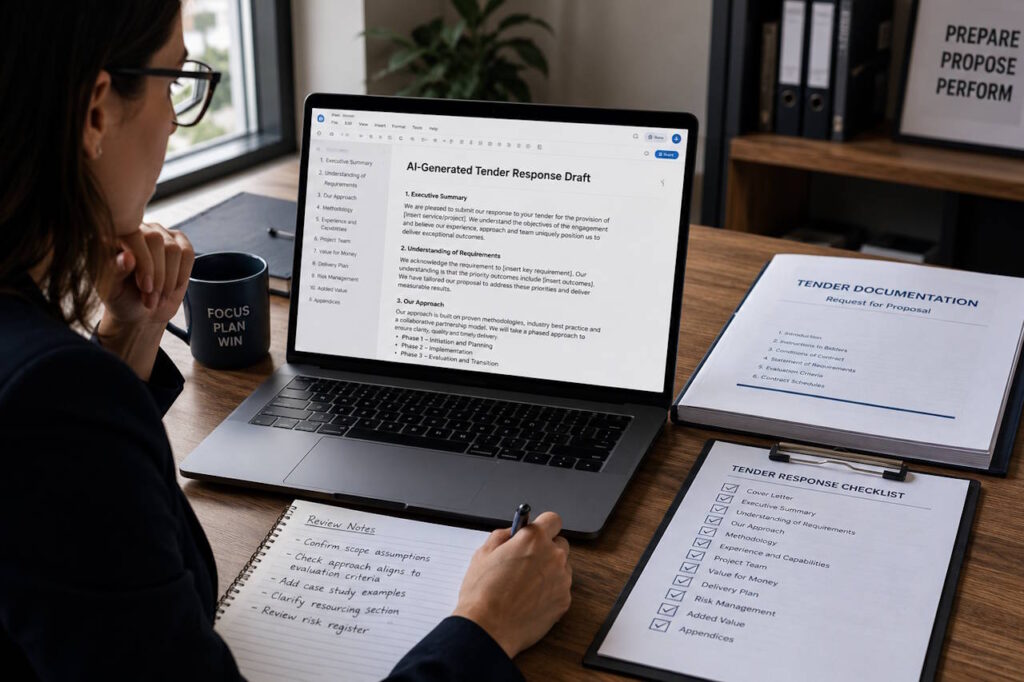
Check AI-assisted content carefully
If AI has been used during the tender writing process, complete a careful human review before submission.
AI can help with structure, first drafts, clarity and editing. However, it can also produce generic wording, unsupported claims or commitments that your business cannot deliver.
Check:
- Is the content accurate?
- Does it answer the exact question?
- Is it tailored to the buyer?
- Are all examples real?
- Are facts, figures and dates correct?
- Has any sensitive information been protected?
- Does the tender ask you to declare AI use?
- Are commitments deliverable?
- Does the response sound like your business?
- Has a person checked it against the scoring criteria?
AI can support bid writing, but it should not be the final reviewer.
Our AI-assisted bid writing service is designed to help SMEs produce structured first-draft tender responses quickly, with experienced bid writers guiding and reviewing the final content.
Check grammar, formatting and readability
A tender response does not need to be literary. It does need to be clear.
Before submitting, check:
- Spelling and grammar
- Consistent headings
- Consistent terminology
- Clear paragraph structure
- Numbered lists where useful
- Table formatting
- Font and spacing requirements
- File names
- Version control
- Page numbers, where needed
- Cross-references
- Acronyms explained where appropriate
Do not let formatting become more important than substance, but remember that evaluators need to read your bid easily.
Dense blocks of text, repeated wording and unclear headings can make a response harder to score.
Test the word count
Word and character limits are part of the tender rules.
Check every answer against the stated limit. Some portals cut text automatically. Others allow uploads but say that content beyond the limit will not be evaluated.
When cutting text, protect the highest-value content:
- Direct answer to the question
- Method and process
- Roles and responsibilities
- Evidence
- Risk controls
- Buyer benefits
- Measurable commitments
Cut:
- Generic introductions
- Repeated claims
- Long company background
- Unnecessary adjectives
- Content that does not answer the question
Shorter answers can still score well if they are clear and specific.
Check attachments and supporting documents
Supporting documents are often where last-minute errors happen.
Check that all attachments are:
- Included
- Current
- Signed where required
- Named clearly
- In the correct format
- Within file size limits
- Consistent with the written response
- Relevant to the tender
- Uploaded to the correct section
Common attachments may include:
- Policies
- Insurance certificates
- Accounts
- Accreditations
- Case studies
- CVs
- Declarations
- Pricing schedules
- Method statements
- Social value documents
- Quality certificates
- Technical documents
Open each file before uploading. Make sure it is the correct version and not a draft with comments, tracked changes or internal notes.
Complete a portal check
Tender portals can create avoidable risk if they are left too late.
Before the deadline, check:
- You can log in
- The right people have access
- The tender is visible
- All required fields are complete
- Files upload correctly
- There are no hidden mandatory questions
- File sizes are accepted
- Portal messages have been reviewed
- Clarification responses have been checked
- Submission confirmation is available
Do not aim to upload at the final minute. Portals can be slow, passwords can fail and files can take longer to upload than expected.
Build in time to fix issues.
Get the right approvals
Before submitting, make sure the right people have approved the final response.
Depending on your business, approval may be needed from:
- Director or business owner
- Finance lead
- Operations lead
- Technical lead
- Health and safety lead
- HR lead
- Data protection or IT lead
- Contract delivery manager
This is especially important where the tender includes commitments around price, staffing, mobilisation, service levels, social value or contract terms.
The person submitting the bid should know that the business can stand behind everything included.
Save a final copy
After submission, save a clean final copy of the tender response.
This should include:
- Final submitted documents
- Pricing files
- Attachments
- Clarification responses
- Portal confirmation
- Submission receipt
- Internal notes on assumptions
- Final version date
This helps if the buyer asks clarification questions after submission. It also gives you a useful reference for future tenders.
If you win, the bid may support mobilisation and contract management. If you lose, the final submission can be reviewed alongside feedback to improve future bids.

Tender submission checklist
Use this checklist before pressing submit.
| Check | Question |
|---|---|
| Instructions | Have we followed the submission rules exactly? |
| Deadline | Are we submitting well before the final deadline? |
| Compliance | Have all mandatory requirements been met? |
| Questions | Has every question and sub-question been answered? |
| Scoring | Does each response follow the evaluation criteria? |
| Evidence | Are claims supported by relevant proof? |
| Buyer focus | Have we explained why our approach benefits the buyer? |
| Consistency | Do all documents tell the same story? |
| Pricing | Is pricing complete, accurate and deliverable? |
| Social value | Are commitments realistic and measurable? |
| AI content | Has any AI-assisted content been checked by a person? |
| Word limits | Are all answers within the required limits? |
| Attachments | Are all files correct, current and clearly named? |
| Portal | Has the portal been checked and completed? |
| Approval | Have the right people approved the final submission? |
| Confirmation | Have we saved submission proof? |
This checklist will not guarantee a win, but it can help reduce avoidable mistakes.
When to get a bid reviewed before submission
A final review can be valuable if the tender is important, complex or being prepared under time pressure.
You may benefit from bid review support if:
- You are unsure whether the answers match the scoring criteria
- Several people have contributed and the bid needs consistency
- You have used previous content and need it tailored
- The tender has a high quality weighting
- The deadline is close
- You want a fresh pair of eyes before submission
- You have lost previous tenders and want to improve scoring
- You need help identifying gaps, repetition or weak evidence
At Bid Writer Consultancy, we support SMEs with bid writing, bid reviews, urgent tenders and AI-assisted first drafts. Our bid writing services can help you check structure, compliance, evidence and buyer focus before submission.
If you are regularly struggling to pull information together at the end of the process, our Bid Ready service can help prepare the documents, case studies and standard content needed for future opportunities.
Submit with confidence
The final stage of a tender can feel rushed, but it is worth protecting time for a proper review.
Before pressing submit, check compliance, evidence, pricing, social value, attachments, portal requirements and approvals. Make sure the response answers the questions, follows the scoring criteria and gives the buyer clear reasons to trust your business.
A strong tender submission is not just well written. It is complete, consistent, realistic and easy to evaluate.
If you are preparing a tender and want a final review before the deadline, contact Bid Writer Consultancy. We can help you check the response, strengthen weak areas and reduce the risk of avoidable submission mistakes.