A 72-hour tender deadline can feel overwhelming. You have found an opportunity that looks relevant, but the clock is already ticking. The tender documents need reviewing, the questions need answering, the pricing needs checking and the portal submission has to be completed on time.
For small and medium-sized businesses, this pressure is even greater. The people who understand the service are often the same people delivering client work, managing teams and running the business. Finding time to produce a strong bid at short notice can be difficult.
A short deadline does not automatically mean you should walk away. Some urgent tenders are still worth pursuing, especially if the opportunity is a strong fit and you already have the right evidence. However, you need a clear plan. With only 72 hours available, there is no room for wasted effort.
This guide explains how to prepare for a 72-hour tender deadline, what to prioritise and when to get support.
First, decide whether the tender is worth bidding for
Before you start writing, take a step back.
When a deadline is tight, it is tempting to jump straight into the response. That can be a mistake. If the tender is a poor fit, you could spend three stressful days producing a bid that has little chance of winning.
Start with a quick bid or no bid decision.
Ask:
- Do we meet all mandatory requirements?
- Is the contract genuinely relevant to our services?
- Do we have evidence of similar work?
- Can we price the contract competitively and profitably?
- Can we complete the submission properly in the time available?
- Is the opportunity important enough to justify the disruption?
- Can we identify a realistic reason why the buyer would choose us?
If the answer to several of these questions is no, the best decision may be not to bid. Saying no to a poor-fit tender can protect time, energy and resource for better opportunities.
If the tender is a strong fit, move quickly into planning.
Read the instructions before the specification
In an urgent bid, compliance matters from the start.
Before reading every detail of the service specification, check the tender instructions. This helps you understand what needs submitting, when it is due and where the risk points are.
Look for:
- Submission deadline and portal requirements
- Clarification deadline
- Word or character limits
- File format requirements
- Mandatory documents
- Pass/fail criteria
- Pricing documents
- Required declarations
- Insurance or accreditation requirements
- Evaluation criteria
- Page limits or attachment rules
- Whether late submissions are accepted
Do not assume the deadline is the only important date. The clarification deadline may already be close, and portal requirements can take longer than expected if registration, permissions or document uploads are involved.
For public sector opportunities, suppliers can use Find a Tender to search for UK public procurement notices and contract opportunities. Tender documents and portal instructions should always be checked carefully once you have found an opportunity.

Build a fast compliance checklist
A compliance checklist is essential when time is short.
This does not need to be complicated. Create a simple list of every required document, question, attachment, declaration and portal action. Then assign an owner and status to each item.
Your checklist might include:
| Requirement | Owner | Status |
|---|---|---|
| Selection questionnaire | Director | In progress |
| Quality question 1 | Operations Manager | Draft needed |
| Quality question 2 | Bid writer | In progress |
| Pricing schedule | Finance | Awaiting review |
| Insurance certificate | Admin | Complete |
| Case studies | Director | To select |
| Declaration form | Director | To sign |
| Portal upload | Admin | Not started |
This keeps the bid under control. It also prevents the team from focusing only on written answers while missing mandatory attachments.
A good urgent bid process is not just about writing quickly. It is about avoiding avoidable errors.
Prioritise the highest-scoring questions
With 72 hours available, you need to use your time carefully.
Read the evaluation criteria and identify which sections carry the most marks. A question worth 25% of the quality score deserves more attention than a short, low-weighted question.
For each quality question, check:
- How much is it worth?
- What is the word limit?
- What does the buyer specifically ask for?
- Are there sub-questions inside the main question?
- What evidence do we have?
- Who needs to provide technical input?
- What would a high-scoring answer need to include?
Do not spend too much time polishing low-value sections before the main scoring areas are drafted. In urgent tendering, sequencing matters.
Write the answers that carry the most marks first.
Break every question down
Tender questions often contain several requirements in one paragraph. If you miss one, you may lose marks.
For example, a question might ask:
“Please describe your approach to mobilisation, including key milestones, roles and responsibilities, communication, risk management and continuity of service.”
This should be broken into separate answer points:
- Mobilisation approach
- Key milestones
- Roles and responsibilities
- Communication
- Risk management
- Continuity of service
Use those points as your structure. This is faster than trying to write from a blank page, and it reduces the risk of missing part of the question.
The Government Commercial Agency’s guide to writing an effective tender bid is a useful external reference for suppliers because it reinforces the need to tailor answers, use relevant evidence and structure responses clearly.

Gather evidence before writing
Do not start every answer from scratch.
Before drafting, gather the evidence you already have. This might include:
- Previous tender responses
- Case studies
- Contract examples
- Policies
- Accreditations
- KPI data
- Client feedback
- Staff CVs
- Mobilisation plans
- Risk registers
- Quality assurance documents
- Social value examples
- Environmental actions
- Complaints procedures
In a 72-hour bid, evidence gathering needs to be fast and focused. Choose the examples that match the tender most closely. Do not spend hours searching for perfect evidence if a good relevant example is already available.
A short, specific proof point is better than a broad unsupported claim.
For example:
“We mobilised a comparable contract within four weeks, completing staff briefings, reporting setup and client handover before go-live.”
This is stronger than:
“We have extensive mobilisation experience.”
Evidence helps the evaluator trust the response.
Allocate roles quickly
Urgent bids fail when everyone assumes someone else is handling the key tasks.
Set roles early. Even for a small team, it helps to know who is responsible for each part of the submission.
You may need:
- A bid lead to manage the process
- A technical lead to provide service detail
- A finance lead to complete pricing
- A reviewer to check quality and compliance
- An administrator to manage documents and portal upload
- A director to approve final content and sign declarations
One person can hold more than one role, especially in an SME. The important thing is that ownership is clear.
If several people are contributing, set short deadlines for internal input. A final deadline of noon on submission day may mean technical drafts are needed by the evening before.
The portal deadline is not the writing deadline.
Create a 72-hour bid timetable
A simple timetable can help keep the process realistic.
Here is an example.
| Time remaining | Priority |
|---|---|
| 72 to 60 hours | Bid or no bid decision, document review, compliance checklist, role allocation |
| 60 to 48 hours | Evidence gathering, clarification questions, answer plans, pricing assumptions |
| 48 to 24 hours | Draft quality responses, complete key documents, develop pricing |
| 24 to 12 hours | Review quality answers, check evidence, finalise pricing, complete attachments |
| 12 to 4 hours | Compliance check, formatting, signatures, file naming, portal preparation |
| Final 4 hours | Upload, review portal submission, submit and save confirmation |
This timetable will vary depending on the tender. The key principle is to protect the final few hours for checking and submission, not first-draft writing.

Ask clarification questions early
If something in the tender is unclear, do not leave clarification questions until the last minute.
You might need to ask about:
- Scope
- Contract volumes
- TUPE information
- Service locations
- Pricing assumptions
- Mobilisation requirements
- Submission instructions
- Evaluation criteria
- Required documents
- Contract terms
Keep clarification questions clear and specific. Do not ask questions that are already answered in the documents, as this can waste time and may not create a good impression.
If the clarification deadline has passed, you will need to make sensible assumptions, but document those assumptions internally. For pricing and delivery risks, it may also be worth stating assumptions clearly where the tender format allows.
Be realistic about what can be written well
In a 72-hour window, you may not be able to write every response from scratch to the standard you would want for a major strategic bid.
That means prioritisation is important.
Focus on:
- Answering the exact question
- Covering every scored point
- Adding relevant evidence
- Explaining your delivery method
- Showing roles and responsibilities
- Linking your approach to buyer benefits
- Avoiding unsupported claims
- Keeping within the word count
Avoid spending too much time on:
- Long company introductions
- Generic values statements
- Overly polished wording
- Rewriting low-scoring sections repeatedly
- Adding unnecessary background detail
- Creating complex graphics unless required
A clear, compliant and evidence-led response is more important than a perfectly polished but rushed submission.
Use existing content carefully
Previous bid content can save time, but it must be adapted.
Do not copy and paste old answers without checking whether they match the current tender. A previous response may be well written, but if it does not answer the new question, it can still lose marks.
When reusing content, check:
- Is the buyer different?
- Is the contract different?
- Has the specification changed?
- Does the evidence still apply?
- Are the figures and dates current?
- Does the response match the new scoring criteria?
- Are commitments still deliverable?
- Does the answer sound specific to this opportunity?
Use previous content as a starting point, not the final answer.
This is especially important with social value, mobilisation, contract management and quality assurance responses, where buyers may ask similar questions but expect different detail.

Use AI carefully, not blindly
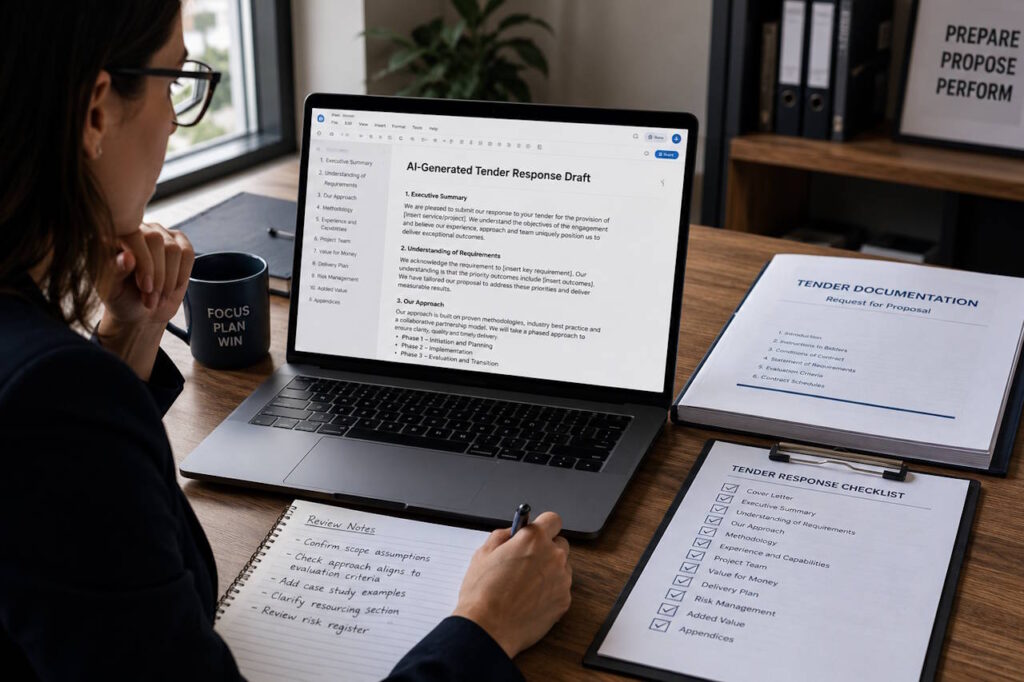
AI can be useful during an urgent tender deadline. It can help turn rough notes into structured drafts, improve clarity and reduce time spent staring at a blank page.
However, AI-generated tender content must be checked carefully.
Before submitting AI-assisted content, check:
- Is it accurate?
- Does it answer the exact question?
- Does it include real evidence?
- Is it tailored to the buyer?
- Are commitments realistic?
- Does it follow the scoring criteria?
- Does it sound like your business?
- Has any sensitive information been handled appropriately?
- Does the tender ask you to declare AI use?
AI can help with speed, but it cannot replace evidence, compliance checking or final human judgement.
At Bid Writer Consultancy, our AI-assisted bid writing service is designed for SMEs that need structured first-draft tender responses quickly, with experienced bid writers guiding and reviewing the content.
Protect time for pricing
Pricing should not be left until the end.
In an urgent tender, the written response and the price need to align. If your quality answers promise a high level of contract management, reporting, mobilisation or social value, the price needs to reflect the cost of delivering those commitments.
Before finalising pricing, check:
- Labour costs
- Materials or equipment
- Travel
- Mobilisation costs
- Management time
- Reporting requirements
- Subcontractor costs
- Inflation or indexation assumptions
- TUPE or staffing implications
- Payment terms
- Risk allowances
- Contract duration and extension options
A rushed pricing schedule can create serious problems. You may submit a price that is too high to compete, too low to deliver profitably or inconsistent with the service described in the quality response.
In urgent bids, pricing should run alongside writing, not after it.
Keep social value realistic
Social value can be difficult under time pressure.
The temptation is to include broad promises that sound positive but are not properly planned. This can weaken the answer and create delivery risk if you win.
For urgent social value responses, keep commitments:
- Specific
- Measurable
- Proportionate
- Linked to the contract
- Owned by a named role
- Realistic within the price
- Supported by previous evidence where possible
For example, instead of saying:
“We will support the local community and create opportunities wherever possible.”
Write something more practical:
“During year one, our Contract Manager will coordinate one employability workshop with a local college or community partner agreed during mobilisation. We will record attendance, feedback and follow-up actions, and report progress during the quarterly contract review.”
This gives the buyer a clearer commitment and shows how it will be managed.
Review the draft against the scoring criteria
Once the main answers are drafted, review them against the scoring criteria before polishing wording.
For each answer, ask:
- Have we answered every part of the question?
- Have we followed the evaluation criteria?
- Have we explained what we will do and how?
- Have we included relevant evidence?
- Have we shown buyer benefits?
- Have we avoided vague claims?
- Have we stayed within the word count?
- Would an evaluator find this easy to score?
This review does not need to take hours, but it should happen before submission.
A tender can read well and still fail to score strongly if it does not follow the buyer’s criteria.
Do a separate compliance check
The final review should include a dedicated compliance check.
This should cover:
- All questions answered
- Word counts checked
- Attachments included
- Declarations signed
- Policies current
- Certificates attached
- Pricing schedule complete
- File names clear
- Portal fields completed
- Clarification responses considered
- Final versions uploaded
- Submission confirmation saved
Ideally, the person doing the compliance check should not be the same person who wrote most of the content. A fresh pair of eyes is more likely to spot missing documents, incomplete fields or version control issues.
If you are working alone, step away briefly before the final check if time allows. Even 20 minutes can help you review more carefully.
Upload earlier than you think
Do not aim to submit at the final minute.
Tender portals can be slow. Files may take longer to upload than expected. Passwords may need resetting. File size limits may create problems. Internet issues can happen at the worst possible time.
Aim to upload well before the deadline.
Before clicking submit, check:
- The correct files are attached
- Draft versions have not been uploaded by mistake
- Portal questions are complete
- Pricing files open correctly
- Declarations are signed
- All required sections show as complete
- Confirmation emails or portal receipts are saved
Submitting early gives you time to fix issues. Submitting at the last minute gives you very little room to recover.

When to get urgent bid writing support
A 72-hour deadline is not always manageable in-house.
You may benefit from urgent bid writing support if:
- The tender is important but the deadline is tight
- You have the evidence but need help turning it into clear answers
- Your team is too busy to draft properly
- The questions are complex or heavily weighted
- You need a compliance check before submission
- You need support structuring AI-assisted drafts
- You are unsure how to prioritise the response
- You want an experienced bid writer to review the bid quickly
At Bid Writer Consultancy, we support SMEs with urgent tender deadlines, bid reviews and AI-assisted first drafts. Our fixed-fee AI Bid Writer service is designed to help businesses produce structured tender responses quickly, while keeping the process human-led and buyer-focused.
For larger or more complex opportunities, our bid management support can help coordinate the process, manage contributors and keep the submission on track.
A 72-hour tender deadline checklist
Use this checklist if you are facing an urgent tender deadline.
| Check | Question |
|---|---|
| Bid decision | Is this opportunity worth bidding for? |
| Compliance | Do we meet all mandatory requirements? |
| Instructions | Have we checked deadline, portal rules and required documents? |
| Scoring | Do we know which questions carry the most marks? |
| Evidence | Have we gathered case studies, policies and proof points? |
| Roles | Does everyone know what they are responsible for? |
| Pricing | Is pricing being developed alongside the written response? |
| Quality answers | Have we answered every part of each question? |
| Social value | Are commitments realistic and measurable? |
| Review | Has the bid been checked against the scoring criteria? |
| Submission | Have we uploaded early and saved confirmation? |
This checklist will not remove the pressure, but it can help bring structure to a short turnaround.
Short deadlines need clear decisions
A 72-hour tender deadline is challenging, but it does not have to become chaotic.
The key is to make decisions quickly. Decide whether the tender is worth bidding for. Build a compliance checklist. Prioritise the highest-scoring questions. Gather evidence early. Protect time for pricing, review and submission.
Most importantly, be realistic. A rushed bid for the wrong opportunity is rarely a good use of time. A focused, compliant bid for the right opportunity can still be worthwhile, especially if you already have strong evidence and a clear delivery approach.
If you are working against a short deadline and need support, contact Bid Writer Consultancy. We can help you decide what to prioritise, structure your responses and move quickly towards a stronger submission.